
Why We Should All Study Religion
By: Casey Hjelmstad
Most people either grow up following a religion without question or reject one without really looking into it (“Who Knows What About Religion?”); however, if a concept is supposed to shape our beliefs, values, and even our purpose in life, should we not be taking the time to understand it? Exploring religion is not just for the deeply faithful; it is something everyone should do. After all, if we do not, we risk basing our entire worldview on assumptions instead of actual understanding (Stavrova). Whether someone sticks with their faith or decides they do not need one, they should at least know for sure why they made that choice. We all owe it to ourselves to genuinely reflect on and explore why we hold the beliefs we have. Therefore, religious or not, people can still find great importance in exploring religion.
Because I am making this argument, it may seem like I am a religious person trying to convert people to live by my own beliefs. Well, that could not be further from the truth. As a matter of fact, I am agnostic, which means I do not really know where I stand with religion; however, I would still argue that people should explore it. If you ask me, the lives of myself and other atheists and agnostics, have no real meaning beyond the meanings we make up to keep ourselves entertained. That may sound kind of depressing, but it is just the reality that no bigger purpose is guiding us through life. Exploring religion forces us to think about whether we are actually okay with creating our own meanings, or if there is a deeper truth more worthy of finding.
Before I go any further, it is important that I explain the concepts of subjective and objective morality: Subjective morality is based on personal opinions, cultural norms, or feelings. It changes depending on who you ask or where you are. For example, what is considered right in one society may be considered wrong in another, and there is no ultimate truth behind it. Objective morality, on the other hand, is the idea that certain things are always right or wrong, no matter what people think. Without religion, there is also no objective morality. Some people suggest you do not need religion to be moral, such as how atheists can still try their best to do what is right; however, if there is no higher power setting a standard, then morality is just based on socially accepted opinions. For example, we all agree that murdering someone in cold blood is wrong, but religious people actually have a reason for why it is objectively wrong. All the rest of us can do is say that it hurts our feelings and is therefore bad. Without religion, what grounds do we really have to say that something is truly evil or immoral? If it is just a matter of opinion, who is to say what is truly right or wrong?
This is not to say religious values cannot be subjective. People interpret religious teachings in all kinds of ways, which leads to different beliefs even within the same religion; however, I still think rules that come from religion feel more objective than anything else. At least, when we study religion, we are aiming for some kind of universal truth, even if we do not all agree on exactly what that truth is. It is a search for something bigger than us, not just personal opinions or societal decisions considered right at the moment. That is why I consider following a religion to be following objective morality.
Some may argue that morality comes from empathy or social contracts, and sure, that is a valid point; however, if morality is just based on feelings or what helps society function, then there is no actual good or evil. There are just actions that society likes, and actions society dislikes. That also means every action is equally selfish. If this idea is true, then someone who spends their life helping the homeless is just as selfish as a thief because they are both doing what makes them feel fulfilled. Thus, exploring religion gives us a chance to actually test these ideas through objective morality, and see if they hold up. It forces us to ask whether there is more to morality than just our personal feelings. Many would respond to this by pointing out that religion is not the only source of morality, and they would not be wrong to consider that. There are many alternative philosophies to live by that have nothing to do with religion; however, while each presents compelling ideas, they also fail to answer some of life’s biggest questions in meaningful ways (Salvatore).
Secular Humanism is probably the most popular alternative. It focuses on being good for goodness's sake, without any religious backing. It is positive and community-oriented, with a focus on improving human welfare; however, it cannot really explain why human rights matter in any deep sense, because it assumes people have value without proving why they do. If there is no higher power or objective truth saying that all humans have equal worth, then human rights are just an idea we made up because it sounds nice. That means everything “good” about Secular Humanism is just based on what most people happen to agree on, not on anything deeper or absolute. It struggles to provide a foundation for objective morality, leaving us with a vague sense of what is right and wrong without any real justification.
Put simply, Nihilism is the idea that nothing matters, and we can do whatever we want. As much as I disagree with it, I honestly don’t have any logical critique of this philosophy besides my lack of enthusiasm for it. This is where religion steps in, offering a sense of purpose that gives our lives real meaning beyond just survival.
Existentialism is another popular approach. It is basically about creating your meaning in life; however, I think existentialism is just nihilism with extra steps. Life is ultimately meaningless if people have to create or pretend one, similar to setting rules if there are none to follow. Also, if there is no real right or wrong, just personal choice, what stops someone from deciding their "meaning" should involve harming others? When really thought about, existentialism is just doing whatever.
Another popular philosophy that is just nihilism in disguise, with a sense of humor, is absurdism. It is all about laughing at the fact that nothing truly matters. While it can feel refreshingly honest, it is hard to actually live this way. When an actual tragedy happens, “nothing matters” is not a helpful approach. For example, if I am speaking about how upset I am that my grandpa died, please do not laugh and tell me how meaningless his life was.
Stoicism is an ancient Greek philosophy that focuses on how we respond to life’s challenges. The main idea of it is that we cannot control everything that happens to us, but we can control how we react to those things. Stoics believe we should focus on what we can control, like our thoughts and actions, and accept things we cannot control, like other people’s behavior or external events. Stoicism has useful advice about maintaining inner peace and emotional resilience, no matter what life throws at us; however, taken too far, it can turn into emotional numbness which is not exactly healthy when dealing with real pain or loss.
Scientific rationalism is all about looking at the world through the lens of facts, logic, and science. It says the best way to figure things out is through observation, testing, and reasoning. Basically, if science lacks evidence or something is immeasurable, the science will render the concept meaningless. Scientific rationalism works for people who want clear, concrete answers to things; however, when it comes to how we should live or what really matters, science falls short. Sure, facts and data are crucial, but they do not answer the bigger questions about meaning, purpose, or values.
Utilitarians would definitely disagree with my claim that morality can only be objective if it is following a religion, because they believe that morality is based on maximizing happiness and minimizing suffering. In their view, an action is right if it leads to the greatest good for the greatest number of people. This sounds nice at first, but there are many flaws with this idea: If morality is just about outcomes, then a lot of heinous acts can be justified. A utilitarian might justify sacrificing one innocent person if it brings happiness to many others. According to the philosophy of utilitarianism, that would be the morally correct thing to do. That is a dangerous way to look at right and wrong, because it justifies almost anything if it benefits the majority. It ignores the value of the individual and turns people into numbers in some kind of math equation. Just because something makes a lot of people feel good does not mean it is right, and without some kind of higher moral standard, utilitarianism cannot actually say why anything is truly wrong.
Now as much as I am criticizing these philosophies, I do not think that they are necessarily “wrong,” per se. They are great partial solutions that each solve a different piece of the puzzle, but leave other important pieces missing, which is why as an agnostic person, I really struggle with figuring out right and wrong. Every one of these philosophies can provide instructions for how to navigate life and morality, but none of them can tell us why.
At this point, you are probably thinking, “This guy is thinking way too deeply about this,” and I can understand why you would feel that way. For many people, morality feels like something you “just know” or pick up from your culture, family, or faith. When someone starts dissecting it at a philosophical level, it can come across as overcomplicating something that should be simple. That is a fair feeling, because the deeper moral philosophy is explored, the more it challenges assumptions and makes the familiar feel uncertain. About a month ago, I was explaining why I struggle with the idea of eating animals to a Christian peer (my explanation is long and unimportant to this paper). What was important, however, was his response: “You are thinking way too deep about this. They are animals, it is okay to eat them.” Now, from the perspective of a Christian or anyone else following an Abrahamic religion, there is nothing wrong with eating animals. Genesis 9:3 says, "Every moving thing that lives shall be food for you" (King James Version); however, like I discussed earlier, as someone who does not have an objective moral compass who cannot use this argument, I have no choice but to think deeply.
The idea that we "should not think too deeply" is ultimately a defense mechanism against discomfort. It implies that curiosity has limits and that some truths are too inconvenient to examine; however, history shows us where this leads: To stagnant beliefs, prejudices, and systems of power that rely on people not asking questions. Yes, overthinking can become unhealthy, but the solution is not to stop thinking; it is to balance reflection with action. Brushing off deep thought as pointless is like refusing to repair a leaky roof because you will just have to fix it again anyway. The reality is that every meaningful human progress came from someone refusing to accept surface-level answers. Even personal growth requires playing with uncomfortable ideas. If we stop at "good enough" understanding, we do not just limit our own knowledge; we outsource our thinking to others, becoming consumers of ideas, rather than active participants in truth. The alternative to overthinking is not blindly accepting the status quo; it is learning to think better.
Let’s think about this for a moment. Do you think we just all decided one day that slavery was wrong and all agreed to stop? Of course not. We had a whole war about it. For example, imagine if everyone just decided that slavery was okay because everyone else was okay with it. Those of us afraid to question morality are the same people who lived through Nazi Germany and blindly accepted that what was happening was okay. Many may consider that comparison extreme, as the Holocaust and slavery are considered some of humanity's worst mistakes in recent history. But who is to say that something happening right now might be considered even worse in the future? It is important to remember that at the time they were happening, slavery and the Holocaust were considered the norm. Until people started to question the morality behind history’s tragedies, nothing could be done about them. For this reason, we must start asking the hard questions that really make us uncomfortable.
So, what if you already have a religion and feel comfortable with it? That is actually more of a reason to explore it. Socrates once said, “The unexamined life is not worth living” (Plato). If a person is basing their whole life on a religion, they should be 100% sure it is actually the right one for them. It is easy to just stay comfortable with a religion without questioning its coherence and truthfulness, but that is not a great way to live. If one cannot explain why they believe what they do, then maybe they need to do more digging. Having faith is wonderful, but it’s important to know the reasoning for our faith. Like I just discussed, it is important to think deeply about our morality and question what does not seem right.
The Pew Forum’s Religious Knowledge Survey shows some pretty shocking gaps in Americans' understanding of religion, even among those who identify as religious. On average, people only got about half of the 32 questions right, and many had trouble with basic topics like history, theology, and interfaith issues. For example, just 8% knew that the 12th-century scholar Maimonides was Jewish, and only 11% recognized Jonathan Edwards, one of America’s most influential theologians, as a preacher during the First Great Awakening. Even when it came to their own faiths, knowledge was often lacking. Only 40% of Americans knew that Catholics believe Communion bread and wine become the body and blood of Christ, and just 16% understood the Protestant doctrine of salvation by faith alone. The survey also showed that people did not know much about world religions. While 85% could define an atheist, far fewer knew about other traditions, only 36% linked Buddhism with nirvana, and just 38% identified Vishnu and Shiva as Hindu gods. Surprisingly, the highest scores came from atheists, agnostics, and Jews, who outperformed evangelical Protestants and Catholics on almost every question. This suggests that religious affiliation does not automatically mean religious knowledge, and that many Americans, regardless of their beliefs, are lacking a basic understanding of global religions, history, and even their own faith ("Who Knows What About Religion?").
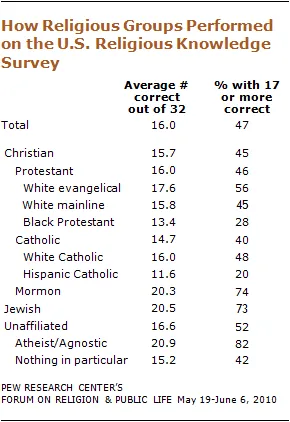
Results of the survey (“Who Knows What About Religion?”)
If we come to the conclusion that we are atheists, that should not stop us from continuing to study religion. Religion is the only moral compass we have beyond our emotions. Even if we do not believe in the theology of a religion, it is still important to understand where others are coming from.
Hinduism, or Sanatana Dharma, encompasses a set of eternal and universal ethical and moral principles of virtuous and true living, acceptable whether or not one is born a Hindu. The Hindu ethical code attaches great importance to values such as truth, right conduct, love, peace, and non-violence. There is the notion that our beliefs determine our thoughts and attitudes, which in turn direct our actions, which in turn creates our destiny. All Hindu ceremonies, rituals, and worships end with a prayer for universal peace and harmony (Northern Territory Government).
An important principle in Hindu thought is karma, the law of cause and effect in which each and every action has a reaction, generating conditions to be experienced within this lifetime or the next. Life is looked upon as a continuum in the sense that the pristine life energy is never destroyed. Death is accepted not as a denial of life but as a process of life. As a result, the Hindu view accepts and believes in samsara (or reincarnation), the cycle of life-death-rebirth until such time as the individual soul, on self-realization of its own essential divinity, emerges into the absolute and the attainment of moksha (or liberation) from the cycles of rebirth (“Hinduism”).
A closely related group is Buddhists, who believe that human beings have the potential to become free from suffering by practicing meditation. Buddha gave a lot of lectures on lifestyle that are now known as the Dharma. Buddhists also believe that after someone dies, they are reincarnated as something new, such as a deity, human, animal, or even something like a ghost, or an inhabitant of hell. It is also believed that all positive thoughts and actions cause good karma, and may direct one into being reborn in a higher form. The consequences of one’s negative deeds, bad karma, may result in rebirth in a lower form. This endless cycle of reincarnation reflects the impermanent nature of human existence (W. Brown).
Buddha also taught the Four Noble Truths: Life is suffering, suffering is caused by craving, suffering can have an end, and that there is a path we can take that leads to the end of suffering. It is believed that suffering, in part, is due to the impermanence of life. Even if one is happy at a given time, this happiness is not permanent. Since it is believed that life is suffering, the ultimate goal in Buddhism is to end the cycle of suffering, the cycle of repeated death and rebirth. The achievement of this goal is called nirvana (W. Brown).
Buddhists believe that the path toward nirvana, also called the Middle Way or the Eightfold Path, outlines how people should live. The Eightfold Path consists of three categories: First, moral conduct is right speech, action, and livelihood. Second, concentration is right effort and mindfulness. Third, wisdom consists of right thought and understanding (W. Brown).
Another group is Abrahamic religions, which started with the God of Abraham. Judaism, the first Abrahamic religion, gets their morality from the Ten Commandments (“Judaism: Basic Beliefs”): Worship no other God, do not create images to worship, do not use the Lord’s name in vain, practice the Sabbath, honor your parents, do not murder, do not commit adultery, do not steal, do not accuse anyone falsely, and do not envy others' possessions (King James Version, Exodus 20.2-17).
Christianity is another Abrahamic religion, but broke off at the introduction of Jesus and the new covenant. Christians believe most of what Judaism teaches, but the key difference is that they believe in the Trinity, the idea that the father, the son, and the holy spirit are all one God. They also believe that accepting Jesus as their lord and savior grants them entry into the kingdom of God. (“Christian Beliefs”).
Islam is an Abrahamic Religion that is also similar to Christianity and Judaism (“The Five Pillars of Islam”). The main difference between the three Abrahamic religions I have mentioned is their view of Jesus. Beyond the typical followings of Abrahamic religions, they also follow the teachings of the prophet Muhammad, who introduced the Five Pillars which form the core of Muslim life, guiding both personal spirituality and community connections through practices like, prayer, almsgiving, fasting, and pilgrimage. These pillars promote discipline, empathy, and a strong bond with God, structuring daily life around reflection and encouraging a deep connection with others (“The Five Pillars of Islam”).
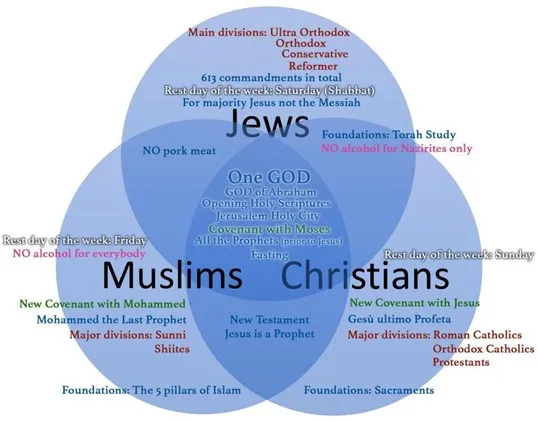
Similarities and differences of the main Abrahamic religions (Mavro)
Many people may stray away from a religion because they believe the teachings are wrong; however, we should not judge other religions based on their morality. As atheists or agnostics, I do not believe we have a true source of objective morality, so it is unfair to put ourselves above them. For example, I do not like how Abrahamic religions view homosexuality, but that is not a valid reason for me to entirely reject the religion. They are simply following a religion as a moral compass, so whatever their religion says is what goes. We should instead question their sources of where they received this information. For example, the Church of Latter-Day Saints used to believe that people of color were former white people who were punished by God for their sins, but after further researching their religious documents, they determined this was not true (Corbitt).
Another reason to explore all religions is that understanding the motivations of those we dislike or consider "evil" can be the key to resolving our conflicts with them. For example, the 9/11 hijackers acted on a misunderstood interpretation of Islamic martyrdom. Another example, white supremacists often distort Christian identity theology to justify racism. As a result, we may simplify people and ignore the beliefs that breed complex humanity in them; however, when we listen to “evil” people’s point of view to understand where they are coming from, we can do amazing things.
Not many stories show the power of listening like the incredible story of Daryl Davis. Daryl Davis is a man who was able to convince over 200 Ku Klux Klan members to leave the group, not by arguing or attacking, but by having honest, respectful conversations with them. He was not out to shame white supremacists; he was curious about them, asking questions like, "How can you hate me when you don’t even know me?" Davis was willing to sit down with people who hated him, listen to their fears and prejudices, and let them see him as a human being. And in doing that, Davis got some incredible results (D. Brown).
Davis’s method worked because he understood that extremism often grows in isolation. A lot of KKK members had never really spoken to a black person. Their hate was a result of stereotypes, not real experiences. By treating them with respect, even when they did not deserve it, Davis started breaking down their views. Over time, some of the people he talked to started questioning their beliefs, not because he preached at them, but because he showed them that a kind, smart, successful black man did not fit the hate-filled stereotypes they had been raised with. Eventually, some of them even handed over their Klan robes to him, leaving their racist views behind (D. Brown).

Davis standing in front of some of the robes he collected from former KKK members (Brown)
So, if I am an atheist and cannot argue that anything is “good,” then who am I to say that the benefits of all these religions I have talked about are even benefits in the first place? Unfortunately, I do not have the answer to that question. All I know is, even if I cannot say what is “good” in some ultimate sense, a lot of what these religions promote such as kindness, forgiveness, or having a sense of purpose, just seems to help people get through life. So, while I cannot prove the benefits of these religions, they still seem to matter to a lot of people, and that counts for something. Besides, the only alternative is choosing our own rules and living selfishly.
At the end of the day, questioning religion is not really about proving anything right or wrong; it is about trying to understand where we and everyone else stand. Whether you stick with your faith, change beliefs, or walk away from religion completely, the important thing is that the choice comes from real thought, not just going with the flow or rebelling for the sake of it. If a belief is believed without exploration, or falls apart with exploration, it should not be used as a foundation of life.
Thinking about religion brings up big questions like where does our sense of right and wrong come from? Does life have any meaning, or do we create it ourselves? Can we really just ignore thousands of years of religious thought without even trying to understand it? Even non-religious ideas have a hard time fully replacing what religion offers, like meaning, a moral base, and community; however, that does not mean religion should get a free pass either. From contradictions in holy texts to the harm done in its name, there are real reasons to ask hard questions.
At the same time, completely throwing religion out means throwing out all the good parts they bring to the table, like Buddhism’s focus on mindfulness, Christianity’s message of loving others, and Islam’s strong sense of community and discipline. Even if you do not believe supernatural aspects, these traditions have shaped how people think for centuries. Ignoring them means missing out on understanding history, culture, and even your own assumptions.
Exploring religion is more about learning how to think than what to think. It challenges us to look at our beliefs, explain why we think what we do, and listen to people who see the world differently. In a world where beliefs shape everything from politics to identity, the real problem is not asking too many questions; it is being so sure you already have all the answers. So, keep searching; you might be surprised by what you find.
Works Cited
Brown, Dwane. "How One Man Convinced 200 Ku Klux Klan Members to Give Up their Robes." MPR News, NPR, 20 Aug. 2017, www.npr.org/2017/08/20/544861933/how-one-man-convinced-200-ku-klux-klan-members-to-give-up-their-robes.
Brown, Waka Takahashi. "Introduction to Buddhism." SPICE, Stanford University, Dec. 2002, spice.fsi.stanford.edu/docs/introduction_to_buddhism. Accessed 23 Feb. 2025.
"Christian Beliefs." United Religions Initiative, www.uri.org/kids/world-religions/christian-beliefs. Accessed 23 Feb. 2025.
Corbitt, Ahmad S. "Revelations in the Summer of 1978." Church History Questions, The Church of Jesus Christ of Latter-day Saints, www.churchofjesuschrist.org/learn/history/church-history-questions/race…. Accessed 9 Feb. 2025.
"Hinduism." Department of Territory Families, Housing and Communities, Northern Territory Government, dpsc.nt.gov.au/media/docs/multicultural-affairs/other-religion-fact-sheets/nt-hinduism-fact-sheet.pdf. Accessed 23 Feb. 2025.
"Judaism: Basic Beliefs." World Religions Curriculum (URI Kids), United Religions Initiative, www.uri.org/kids/world-religions/jewish-beliefs. Accessed 23 Feb. 2025.
Mavro. “Abrahamic Religions: Similarity and Comparison.” Abrahamic Study Hall, 4 Apr. 2017, www.abrahamicstudyhall.org/2017/04/04/abrahamic-religions-similarity-comparision/.
Plato. “Apology.” Plato: Complete Works, translated by G.M.A. Grube, edited by John M. Cooper, Hackett Publishing Company, 1997, pp. 17–36.
Salvatore, Leo. "The Least Harm Principle." Medium, 25 Jun. 2020, medium.com/@leosa383/the-least-harm-principle-2b72c0ac9ee5.
Stavrova Olga, et al. “Why are Religious People Happy? The Effect of the Social Norm of Religiosity Across Countries.” NCBI, NLM, NIH, 25 Jul. 2012. pubmed.ncbi.nlm.nih.gov/23146600/.
"The Five Pillars of Islam." Art of the Islamic World, MET, www.metmuseum.org/learn/educators/curriculum-resources/art-of-the-islam…. Accessed 23 Feb. 2025.
“The King James Version of the Bible.” Project Gutenberg, 2011, www.gutenberg.org/ebooks/10.
"Who Knows What About Religion?" Research Topics, Pew Research Center, 28 Sept. 2010, www.pewresearch.org/religion/2010/09/28/u-s-religious-knowledge-survey-who-knows-what-about-religion/. Accessed 9 Feb. 2025.