
Problematic Internet Use and Influence on Quality of Sleep and Generalized Anxiety
Aubart, A., Velasquez, D., Bursch, A., Lee, P., Shaw, E, Robertson, J., Cedergren, H., Chang, E., Duopu, B., Adam, S.
Psychology Department, North Hennepin Community College
Dr. Debra Matchinsky
April 11, 2026
Abstract
Problematic internet use (PIU), or internet addiction, is a growing concern, as research shows that various types (i.e., gaming, social media, reels, etc.) can lead to issues with sleep and anxiety among other health related issues (i.e., substance addiction, self-esteem, depression, loneliness, etc.). We focused on the 2 most common issues - sleep and anxiety - related to PIU. Participants were 41 students from a diverse community college campus (mean age = 24.75 years): 19.52% male, 65.85% female, and 14.63% trans/nonbinary; 26.83% White, 19.51% multiracial, 14.63% Asian, 12.20% African Black, 9.76% African American/Black, and 7.32% Hispanic/Latino, with 73.17% born in the U.S. Our hypothesis was supported by both poor sleep quality measured by the Pittsburgh Sleep Quality Index (r = 0.43, p < .005), and generalized anxiety disorder measured by the GAD-7 (r = 0.44, p < .003), which are significantly related to PIU measured by the Internet Addiction Test. Future research will examine if reducing PIU in college students will improve anxiety and sleep.
Problematic Internet Use and Influence on Quality of Sleep
and Generalized Anxiety
PIU and Demographics
Internet usage is very prevalent in most people’s lives. At work, school, and home people use the internet. Internet addiction becomes a potential concern when Internet usage is excessive and negatively affects behaviors such as impulse control, daily functioning, real-life relationships, and mood (Cash et al., 2012; Shaw & Black, 2008). Reportedly, 65% of U.S. adults are using some type of social networking site to connect with others (Perrin 2015). Of adults aged 18 to 29, 90% use the Internet, yet correlations indicate a decrease in usage as a person gets older. Additionally, people with some level of college education are more likely to use social media than people who have not obtained more than a high school diploma (Perrin, 2015).
PIU positively relates to age for role-playing games, online gambling, auction websites, and media streaming (Ioannidis et al., 2018). However, Ainin and colleagues (2017) found the highest PIU scores among those 21-39, with lower scores in those younger and older. In a large Japanese study of junior high students, statistics show that the earlier a child starts using the internet or has access to a cellphone, the more likely they are to develop PIU (Nakayama et al., 2020).
A recent literature review suggests that culture and gender influence PIU outcomes such as severity and symptoms (Baloğlu et al., 2020). For instance, people from Asian countries score higher in both categories (Balhara, 2019; Peterka-Bonetta et al., 2019; Su et al., 2019; Yang et al., 2019). While men experience more symptoms of general PIU, women report more symptoms related to specific types of PIU like issues with social media or smartphone usage (Baloğlu et al., 2020). In Turkey, 18–25-year-old males are more likely to have higher scores on PIU (Durak et al., 2013). However, among Malaysian (Ainin, et al., 2017), U.S., and South African adults (Ioannidis et al., 2018), there is no difference between gender.
PIU and Addiction
American Psychological Association’s Dictionary of Psychology defines Internet addiction as a problematic behavioral pattern involving excessive and obsessive computer use that results in distress and impairment (American Psychological Association, 2018). Further research recognizes subtypes of addiction, such as gaming, sexual fixation, and socializing (Shafer, 1996; Young, 1999). The Internet may become addictive as users experience psychological rewards when participating in online forums. For instance, video games offer exciting visual stimulation, gratification from winning, and a sense of community. Over time, attempts to maintain these experiences can turn into problematic behavior as users start to rely on this reward source (Cash et al., 2012).
Similar to how a casino fosters a gambling addiction, and a mall fosters a shopping addiction, the Internet conveniently facilitates addictions like gaming, social media, pornography, and more (Shaffer, 1996). The former are not called a "casino addiction" or "mall addiction." Instead, they are named after behaviors. Considering this logic, Internet addiction has been considered by some researchers to be an inaccurate umbrella term, covering addictions not to the Internet; but enabled by it. The Center for Internet Addiction (founded by Dr. Kimberly Young in 1995, provides treatment for Internet addiction using CBT-IA) has identified five subtypes of Internet addiction: cybersex, cyber-relationships, online stock trading or gambling, information seeking, and gaming (Young, 1998). Widyanto and Griffiths (2006) classify five main areas of research on Internet addiction: comparisons between excessive and non-excessive Internet users, studies of high-risk groups such as students, research on psychological factors and assessment tools, case studies of individual experiences and treatments, and studies examining links between excessive Internet use and related issues like mental health, and self-esteem.
Aside from the APA’s definition, Internet addiction has been operationalized in various ways. For instance, Kandell (1998) defines PIU as a psychological reliance on the Internet that develops separately from and despite the activities being engaged in. PIU shares similar features with other impulse control disorders such as gambling addiction and kleptomania (Shaw & Black, 2008; Young, 1998). Within the DSM-IV, pathological gambling is the most similar to the compulsive nature of Internet use. Using pathological gambling as a framework, Young (1998) states that Internet addiction can be classified as an impulse-control disorder without substance intoxication.
Since its inception, the Internet has continued to develop and expand, while daily usage has increased with social media platforms (Brügger, 2015; Gallagher, 2018; Maryville University, 2020). In fact, some of the most popular Internet sites have come from college students looking for easier ways to connect. Availability of gambling, pornography/cyber sex, etc. subsequently increases screen time and the risk of problematic use as a disorder by the American Psychiatric Association (2018). Pan and colleagues (2020) compiled data from over 100 studies and 600,000 people, and found that generalized Internet addiction is a serious issue, highlighting a growth in “human-machine interaction.”
PIU Among College Students
PIU is more common among female college students (more likely to access socialization, chats and social networks) than males (more likely to access entertainment, games or shopping online) (Fernández-Villa, et al., 2015). In U.S. college students, dependent and excessive use are the two most salient factors in the IAT (Jelenchick et al., 2012). Christakis and colleagues (2011) found that 4% of college students have PIU, and 12% have moderate to severe depression linked to 13 out of 17 internet behaviors. Derbyshire and colleagues (2013) also found that 12.9% of college students have limited internet use, while 81.8% have mild use, and 5.3% have moderate to severe use. Depression makes it 24 times more likely for a student to develop PIU, due to lower grade point averages (GPA), less exercise, and high stress levels etc. (p = 0.001, p = .006, p = .018, p < .0001). Thus, younger (32.78% of those aged 18 to 20) and gender-diverse (41.54%) college students have higher PIU scores (Qeadan et al., 2022).
PIU and Sleep
Many studies have also shown that internet use and sleep quality have a strong negative correlation (Alimoradi et al., Kokka et al., 2021; 2019; Lin et al., 2019). Interruptions in sleep, such as insomnia, increase with higher rates of PIU in adolescents (Islam, 2021; Kokka et al., 2021). Internet addiction is linked to worse sleep in female college students, including feeling tired during the day (Lin et al., 2019). Those with severe addiction sleep worse than those with mild or no addiction. Other sleep problems include inability to focus during the day, due to suppression of melatonin secretion caused by blue light emissions (Alimoradi et al., 2019). One study found that participants who sleep less spend almost twice as much time on the internet, delaying the sleep and wake cycle (Kim et al, 2018).
Problematic Internet Use and Anxiety
A correlation between PIU and anxiety has also been found in many studies (Balhara, 2019; Ding, et al., 2023; Spada, 2014). Kim et al. (2016) conducted one of these studies, showing that individuals with PIU are 2.19 times more likely to have an anxiety disorder, and 2.26 times more likely to have generalized anxiety disorder (GAD). In another study conducted by Baloğlu and colleagues (2018), findings show that men are more likely to experience PIU, while men and women were equally likely to experience social anxiety.
It has been found that the prevalence of GAD and PIU has risen since the COVID-19 pandemic (Lakkunarajah, et al., 2022). High GAD-7 scores significantly relate to high Problematic and Risky Internet Use Screening Scale scores in those age 12-23 after the pandemic. A study by Király et al. (2020) explains that videogaming, social media use, and browsing the internet can all be possible sources of escaping/coping with anxiety, which can further lead to Internet addiction.
Methods
Participants
Students at a diverse, suburban, Minnesota community college were invited to participate through a post on the student app and invitation by instructors’ learning management system. The posts informed the potential participants of the purpose and requirement to be at least 18 years old, and contained a link to the Qualtrics study consent form. The informed consent included the purpose, right to withdraw at any time, possible risks and benefits, and contact information. Once consent was given, the student proceeded through the assessments and was provided with a debrief/thank you at the end with contact information and referral to NHCC counseling if needed.
Of the 41 students who completed the full study, 27 (65.85%) were female, 8 (19.52%) were males, and 6 (14.63%) were trans/nonbinary; 11 (26.83%) were White, 8 (19.51%) multiracial, 6 (14.63%) Asian, 5 (12.20%) African Black, 4 (9.76%) African American/Black, 3 (7.32%) Hispanic/Latino, 2 (4.88%) Middle/Eastern/North African, and 2 (4.88%) did not report. 73.17% were born in the U.S., and the average age was 24.75 years. The number of credits earned after the semester ranged from 3 to 96, with an average of 27.94. The GPAs ranged from 2.0 to 4.0, with an average of 3.47. About 10 (24.4%) reported having a disability, and 5 (12.20%) reported having a mental health disorder.
Materials
GAD-7
The GAD-7, created by Spitzer and coresearchers (2006), is a seven-item scale that assesses the severity of GAD on a four-point Likert scale ranging from “not at all” to “nearly every day” over two weeks. Items measure worry, irritability, feeling on edge, and problems with relaxing. A total score of 0-4 indicates minimal anxiety, 5-9 mild anxiety, 10-14 moderate anxiety, and 15-21 shows severe anxiety.
Research done by Dhira et al. (2021) found that the GAD-7 has high reliability (0.895) and validity (0.915). In support of this, Kertz, et al. (2012) states that the GAD-7 is a good measure to use, due to the excellent clinical utility and strong psychometric properties in primary care. They found good constancy and convergent reliability, but the instrument is better at identifying symptoms of anxiety than a diagnosis of GAD.
Pittsburgh Sleep Quality Inventory
The Pittsburgh Sleep Quality Inventory (PSQI), created by Buysse and colleagues (1989), is a simple assessment that distinguishes “good” and “poor” sleepers. The seven components include: subjective sleep quality, sleep latency, sleep duration, habitual sleep efficiency, sleep disturbances, use of sleeping medication, and daytime dysfunction. These components are scored on a Likert-type questionnaire (scale from 0-3), with a total score range of 0-21. A global PSQI score of >5 signifies poor quality of sleep or difficulties within the measured components. In addition, this instrument has excellent internal reliability (Cronbach α = 0.83), test-retest reliability (0.85) for the global scale, a sensitivity of 89.6%, and specificity of 86.5% (Shahid et al., 2012). The PSQI more closely relates to psychological symptom ratings and sleep diary measures than other types of sleep instruments (Buysse et. al, 2008).
Internet Types Use Scale
The Internet Types Use Scale (ITUS), based on the research of Rozgonjuk, et al. (2022) and Widyanto & Griffiths (2006), determines specific activities on the internet that may be addictive. Addictive potential has been found for gaming (Huang, 2006; Ioannidis, et al., 2018; Kuss, et al., 2013; Kuss & Griffiths, 2012; Leung, 2004; Rozgonjuk, et al., 2022), social applications (Huang, 2006; Kuss, et al., 2013; Leung, 2004; Rozgonjuk, et al., 2022), social networking sites (Ioannidis, et al., 2018; Kuss, et al., 2013; Kuss & Griffiths, 2011; Leung & Lee, 2012; Rozgonjuk, et al., 2022), shopping (Ioannidis, et al., 2018; Kuss, et al., 2013; Rozgonjuk, et al., 2022 ) and pornography (Ioannidis, et al., 2018; Rozgonjuk, et al., 2022). Researchers found a relationship between PIU and role-playing games (β = 0.33), online gambling (β = 0.15), use of auction websites (β = 0.35), and streaming media (β = 0.35), linking older age groups with elevated amounts of PIU (Ioannidis et al., 2018). Usage of internet services is higher for gaming (58.1%) in boys, and blogging (22.1%) and messenger/chatting (20.3%) in girls (Kim, et al., 2020). The scale consists of eight types of internet use, rated on a Likert scale from 1-5 with high scores showing more use.
Internet Addiction Test
The Internet Addiction Test (IAT), developed by Kimberly Young (2017), is a 20-item questionnaire that evaluates the severity and effects of a person’s internet use. The assessment measures several factors of PIU, including behavior, dependence, escapism, and compulsion. Respondents rate each statement on a five-point Likert scale, with scores from 0 to 30 indicating a normal level of Internet usage, 31 to 49 suggesting mild dependence, 50 to 79 for moderate dependence, and scores of 80 to 100 signifying severe dependence.
The IAT shows strong reliability and validity across different age groups (Moon et al., 2018). For college students, the internal consistency is high (Cronbach's alpha = 0.90) and test-retest reliability is good (r = 0.83). Widyanto and McMurran (2004) identified six factors of the IAT: salience, excessive use, neglecting work, anticipation, lack of control, and neglecting social life. Jelenchick and colleagues (2012) studied two U.S. universities where the dependent and excessive use categories collectively accounted for 91% of the total variance. Participants identified as problematic users scored 0.8 ± 1.5 points higher on “dependent” and 1.4 ± 1.5 points higher on “excessive” internet use on average, as measured by the IAT.
Results
Our hypothesis was supported in that both poor sleep quality as measured by the PSQI (r = 0.43, p < .005) and GAD as measured by the GAD-7 (r = 0.44, p < .003), which significantly relate to PIU as measured by the IAT. Addiction levels were 59.52% mild and 14.28% moderate, with no one reaching a severe level. Interestingly, 100% of the students indicated poor sleep, and 23% had moderate and 21% severe anxiety. Sleep is very important for functioning, promoting both mental (Zhang et al., 2018) and physical health (Wong et al., 2013), and low levels of sleep can lead to unhealthy lifestyle choices (Kim et al., 2018), one being excessive internet use.
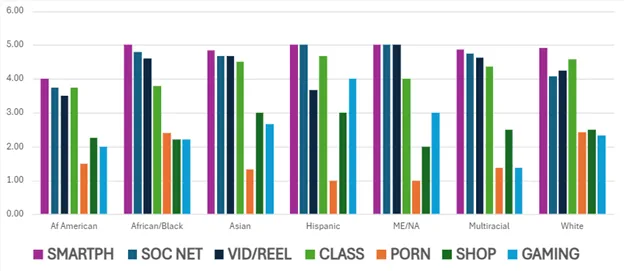
PIU also significantly relates to higher levels of anxiety (r = 0.93, p < 0.01) in younger ages (r = -0.35, p < 0.05). High scores on the IAT have significant correlations with specific sleep issues, namely: struggling to fall asleep within 30 minutes (r = 0.37, p < 0.05) and waking up in the middle of the night (r = 0.30, p < 0.05). Usage of porn and sex sites also have a significant correlation to having nightmares (r = 0.30, p < 0.05). Significant correlation is found between online gaming and anxiety (r = 0.36, p < 0.05) and irritability (r = .49, p < 0.01). Thus, types of Internet use appear to stay relatively consistent across the different demographics (See Figure 1., Figure 2., and Figure 3.), with smart phone use as the most common. The greatest variety in types of Internet (porn, shopping, and gaming) use is among the different race groups (See Figure 3.)
Figure 1. Types of Internet use by Age
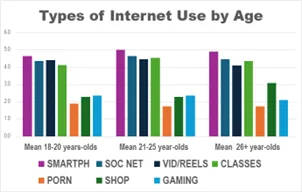
Figure 2. Types of Internet use by Gender
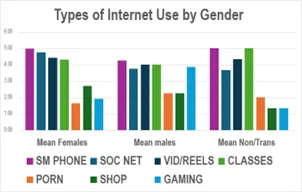
Figure 3. Types of Internet Use by Race
Discussion
Our study supported the importance of sleep quality as a correlate of PIU. This parallels the findings of Alimoradi et al. (2019) and Kokka et al. (2021) who demonstrate that addiction leads to poor sleep quality. Canan et al. (2013) utilize the IAT and found supporting results with the average hours of sleep decreasing as IAT scores increased; 7.8 hours for average, 7.3 for problematic, and 6.9 for addictive users.
Similar to previous studies that do not examine directionality in the relationship, these results reveal a significant correlation between PIU and anxiety symptoms. A multi-national study of college/university students across 8 countries also found consistent support for the existing relationship (Balhara, 2019). An overview of PIU prevalence in different psychiatric disorders across South Korea (2007-2008) shows higher rates of internet usage in patients who suffer from anxiety disorders and GAD (Kim, et al., 2016). Interestingly, a meta-analysis found that social anxiety predicts PIU in teens and young adults (Ding et al., 2023).
While our study does help support the growing understanding of limiting Internet use to reduce sleep and mental health concerns, it is important to recognize its limitations. Our sample size (41 students), despite including a variety of diverse cultures, is too small to make sweeping generalizations. Since all participants reported sleep issues, there is a possible biased self-selection of participants who had sleep difficulties. The ITUS may be revised for future studies. The “Smart Phone” type was found to measure a combination of types of use, so it may be reconsidered for use as an overall Internet use category.
Future research may consider looking at online school and work activities to explore how they contribute to PIU. Moreover, the correlations found may inspire future researchers to explore the directionality of these relationships through an experimental design. It may be considered that PIU serves as a moderator between anxiety and sleep issues. Given that we found falling asleep and staying asleep to be more difficult for those with higher PIU scores, future studies may also look at when the Internet is used and how the time of day of use (i.e., before bed) affects those sleep results.
References
American Psychological Association. (2018). Internet addiction. APA Dictionary of Psychology. https://dictionary.apa.org/internet-addiction
Ainin, S., Jaafar, N. I., Ashraf, M., & Parveen, F. (2017). Exploring the role of demographics and psychological variables in internet addiction. Social Science Computer Review, 35(6), 770-780. https://doi.org/10.1177/0894439316667396
Alimoradi, Z., Lin, C. Y., Broström, A., Bülow, P. H., Bajalan, Z., Griffiths, M. D., Ohayon, M. M., & Pakpour, A. H. (2019). Internet addiction and sleep problems: A systematic review and meta-analysis. Sleep Medicine Reviews, 47, 51-61. https://doi.org/10.1016/j.smrv.2019.06.004
Balhara, Y. P. S., Doric, A., Stevanovic, D., Knez, R., Singh, S., Chowdhury, M. R. R., Kafali, H. Y., Sharma, P., Vally, Z., Vu, T. V., Arya, S., Mahendru, A., Ransing, R., Erzin, G., & Le, H. L. T. C. H. (2019). Correlates of problematic internet use among college and university students in eight countries: An international cross-sectional study. Asian Journal of Psychiatry, 45, 113-120. https://doi.org/10.1016/j.ajp.2019.09.004
Baloğlu, M., Özteke Kozan, H. İ., & Kesici, Ş. (2018). Gender differences in and the relationships between social anxiety and problematic internet use: Canonical analysis. Journal of Medical Internet Research, 20(1), e33. https://doi.org/10.2196/jmir.8947
Baloğlu, M., Şahin, R., & Arpaci, I. (2020). A review of recent research in problematic internet use: Gender and cultural differences. Current Opinion in Psychology, 36, 124-129. https://doi.org/10.1016/j.copsyc.2020.05.008
Brügger, N. (2015). A brief history of Facebook as a media text: The development of an empty structure. First Monday, 20(5). https://doi.org/10.5210/fm.v20i5.5423
Buysse, D. J., Hall, M. L., Strollo, P. J., Kamarck, T. W., Owens, J., Lee, L., Reis, S. E., & Matthews, K. A. (2008). Relationships between the Pittsburgh Sleep Quality Index (PSQI), Epworth Sleepiness Scale (ESS), and clinical/polysomnographic measures in a community sample. Journal of Clinical Sleep Medicine, 4(6), 563-571. https://doi.org/10.5664/jcsm.27351
Buysse, D. J., Reynolds III, C. F., Monk, T. H., Berman, S. R., & Kupfer, D. J. (1989). The Pittsburgh Sleep Quality Index: A new instrument for psychiatric practice and research. Psychiatry Research, 28(2), 193-213. https://doi.org/10.1016/0165-1781(89)90047-4
Canan, F., Yildirim, O., Sinani, G., Ozturk, O., Ustunel, T. Y., & Ataoglu, A. (2013). Internet addiction and sleep disturbance symptoms among Turkish high school students. Sleep and Biological Rhythms, 11(3), 210-213. https://doi.org/10.1111/sbr.12022
Cash, H., Rae, C. D., Steel, A. H., & Winkler, A. (2012). Internet addiction: A brief summary of research and practice. Current Psychiatry Reviews, 8(4), 292-298. https://doi.org/10.2174/157340012803520513
Christakis, D. A., Moreno, M. M., Jelenchick, L., Myaing, M. T., & Zhou, C. (2011). Problematic internet usage in US college students: A pilot study. BMC Medicine, 9, 77. https://doi.org/10.1186/1741-7015-9-77
Derbyshire, K. L., Lust, K. A., Schreiber, L. R., Odlaug, B. L., Christenson, G. A., Golden, D. J., & Grant, J. E. (2013). Problematic Internet use and associated risks in a college sample. Comprehensive Psychiatry, 54(5), 415-422. https://doi.org/10.1016/j.comppsych.2012.11.003
Dhira, T. A., Rahman, M. A., Sarker, A. R., & Mehareen, J. (2021). Validity and reliability of the Generalized Anxiety Disorder-7 (GAD-7) among university students of Bangladesh. PLOS One, 16(12), e0261590. https://doi.org/10.1371/journal.pone.0261590
Ding, H., Cao, B., & Sun, Q. (2023). The association between problematic internet use and social anxiety within adolescents and young adults: A systematic review and meta-analysis. Frontiers in Public Health, 11. https://doi.org/10.3389/fpubh.2023.1275723
Durak, M., & Şenol Durak, E. (2013). Associations of social anxiety and depression with cognitions related to problematic internet use in youths. Eğitim ve Bilim, 38(169), 19-29. https://doi.org/10.15390/ES.2013.1154
Fernández-Villa, T., Ojeda, J. A., Gómez, A. A., Carral J. M. C., Delgado-Rodríguez, M., García-Martín, M., Jiménez-Mejías, E., Llorca, J., Molina, A. J., Moncada, R. O., Valero-Juan, L. F., & Martín, V. (2015). Problematic internet use in university students: Associated factors and differences of gender. Adicciones, 27(4), 265-275. https://doi.org/10.20882/adicciones.751
Gallagher, B. (2018). How to turn down a billion dollars: The Snapchat story. St. Martin's Press
Huang, Y. R. (2006). Identity and intimacy crises and their relationship to internet dependence among college students. CyberPsychology & Behavior, 9(5), 571-576. https://doi.org/10.1089/cpb.2006.9.571
Ioannidis, K., Treder, M. S., Chamberlain, S. R., Kiraly, F., Redden, S. A., Stein, D. J., Lochner, C., & Grant, J. E. (2018). Problematic internet use as an age-related multifaceted problem: Evidence from a two-site survey. Addictive Behaviors, 81, 157-166. https://doi.org/10.1016/j.addbeh.2018.02.017
Islam, Z., Hsan, K., Islam, S., Gozal, D., & Hossain, M. (2021). Assessment of sleep quality and its association with problematic internet use among university students: A cross-sectional investigation in Bangladesh. Sleep Science, 14(S01), 8-15. http://doi.org/10.5935/1984-0063.20200069
Jelenchick, L. A., Becker, T., & Moreno, M. A. (2012). Assessing the psychometric properties of the Internet Addiction Test (IAT) in US college students. Psychiatry Research, 196(2-3), 296-301. https://doi.org/10.1016/j.psychres.2011.09.007
Kandell, J. J. (1998). Internet addiction on campus: The vulnerability of college students. Cyberpsychology & Behavior, 1(1), 11-17. https://doi.org/10.1089/cpb.1998.1.11
Kertz, S., Bigda-Peyton, J., & Bjorgvinsson, T. (2012). Validity of the Generalized Anxiety Disorder-7 Scale in an acute psychiatric sample. Clinical Psychology & Psychotherapy, 20(5), 456-464. https://doi.org/10.1002/cpp.1802
Kim, B. S., Chang, S. M., Park, J. E., Seong, S. J., Won, S. H., & Cho, M. J. (2016). Prevalence, correlates, psychiatric comorbidities, and suicidality in a community population with problematic Internet use. Psychiatry Research, 244, 249-256. https://doi.org/10.1016/j.psychres.2016.07.009
Kim, K. M., Kim, H., Choi, J. W., Kim, S. Y., & Kim, J. W. (2020). What types of internet services make adolescents addicted? Correlates of problematic internet use. Neuropsychiatric Disease and Treatment, 16(2020), 1031-1041. https://doi.org/10.2147/NDT.S247292
Kim, S. Y., Kim, M. S., Park, B., Kim, J. H., & Choi, H. G. (2018). Lack of sleep is associated with internet use for leisure. PLOS One, 13(1), e0191713. https://doi.org/10.1371/journal.pone.0191713
Király, O., Potenza, M. N., Stein, D. J., King, D. L., Hodgins, D. C., Saunders, J. B., Griffiths, M. D., Gjoneska, B., Billieux, J., Brand, M., Abbott, M. W., Chamberlain, S. R., Corazza, O., Burkauskas, J., Sales, C. M. D., Montag, C., Lochner, C., Grünblatt, E., Wegmann, E., … Demetrovics, Z. (2020). Preventing problematic internet use during the COVID-19 pandemic: Consensus guidance. Comprehensive Psychiatry, 100, e152180. https://doi.org/10.1016/j.comppsych.2020.152180
Kokka, I., Mourikis, I., Nicolaides, N. C., Darviri, C., Chrousos, G. P., Kanaka-Gantenbein, C., & Bacopoulou, F. (2021). Exploring the effects of problematic internet use on adolescent sleep: A systematic review. International Journal of Environmental Research and Public Health, 18(2), 760. https://doi.org/10.3390/ijerph18020760
Kuss, D. J., & Griffiths, M. D. (2011). Online social networking and addiction—a review of the psychological literature. International Journal of Environmental Research and Public Health, 8(9), 3528-3552. https://doi.org/10.3390/ijerph8093528
Kuss, D. J., & Griffiths, M. D. (2012). Internet gaming addiction: A systematic review of empirical research. International Journal of Mental Health and Addiction, 10, 278-296. https://doi.org/10.1007/s11469-011-9318-5
Kuss, D. J., Griffiths, M. D., & Binder, J. F. (2013). Internet addiction in students: Prevalence and risk factors. Computers in Human Behavior, 29(3), 959-966. https://doi.org/10.1016/j.chb.2012.12.024
Lakkunarajah, S., Adams, K., Pan, A. Y., Liegl, M., & Sadhir, M. (2022). A trying time: Problematic Internet Use (PIU) and its association with depression and anxiety during the COVID-19 pandemic. Child and Adolescent Psychiatry and Mental Health, 16(49). https://doi.org/10.1186/s13034-022-00479-6
Leung, L. (2004). Net-generation attributes and seductive properties of the internet as predictors of online activities and internet addiction. Cyberpsychology & Behavior, 7(3), 333-348. https://doi.org/10.1089/1094931041291303
Leung, L., & Lee, P. S. (2012). The influences of information literacy, internet addiction and parenting styles on internet risks. New media & society, 14(1), 117-136. https://doi.org/10.1177/1461444811410406
Lin, P. H., Lee, Y. C., Chen, K. L., Hsieh, P. L., Yang, S. Y., & Lin, Y. L (2019). The relationship between sleep quality and internet addiction among female college students. Frontiers in Neuroscience, 13, e599. https://doi.org/10.3389/fnins.2019.00599
Liu, T. C., Desai, R. A., Krishnan-Sarin, S., Cavallo, D. A., & Potenza, M. N. (2011). Problematic Internet use and health in adolescents: Data from a high school survey in Connecticut. The Journal of Clinical Psychiatry, 72(6), 836-845. https://doi.org/10.4088/JCP.10m06057
Löwe, B., Decker, O., Müller, S., Brähler, E., Schellberg, D., Herzog, W., & Herzberg, P. Y. (2008). Validation and standardization of the Generalized Anxiety Disorder Screener (GAD-7) in the general population. Medical Care, 46(3), 266-274. https://doi.org/10.1097/MLR.0b013e318160d093
Maryville University. (2020, May 28). The evolution of social media: How did it begin, and where could it go next. Maryville University. https://online.maryville.edu/blog/evolution- social-media/
Moon, S. J., Hwang, J. S., Kim, J. Y., Shin, A. L., Bae, S. M., & Kim, J. W. (2018). Psychometric properties of the Internet Addiction Test: A systematic review and meta- analysis. Cyberpsychology, Behavior, and Social Networking, 21(8), 473-484. https://doi.org/10.1089/cyber.2018.0154
Nakayama, H., Ueno, F., Mihara, S., Kitayuguchi, T., & Higuchi, S. (2020). Relationship between problematic Internet use and age at initial weekly Internet use. Journal of Behavioral Addictions, 9(1), 129-139. https://doi.org/10.1556/2006.2020.00009
Pan, Y. C., Chiu, Y. C., & Lin, Y. H. (2020). Systematic review and meta-analysis of epidemiology of internet addiction. Neuroscience & Biobehavioral Reviews, 118, 612-622. https://doi.org/10.1016/j.neubiorev.2020.08.013
Perrin, A. (2015). Social media usage: 2005-2015. Pew Research Center, 125, 52-68.
Qeadan, F., Egbert, J., & English, K. (2022). Associations between problematic internet use and substance misuse among US college students. Computers in Human Behavior, 134, e107327. https://doi.org/10.1016/j.chb.2022.107327
Rozgonjuk, D., Schivinski, B., Pontes, H. M., & Montag, C. (2022). Problematic online behaviors among gamers: The links between problematic online gaming, gambling, shopping, pornography use, and social networking. International Journal of Mental Health and Addiction, 21, 240-257. https://doi.org/10.1007/s11469-021-00590-3
Shaffer, H. J. (1996). Understanding the means and objects of addiction: Technology, the internet, and gambling. Journal of Gambling Studies, 12(4), 461-469. https://doi.org/10.1007/BF01539189
Shahid, A., Wilkinson, K., Marcu, S., & Shapiro, C. M. (2012). Pittsburgh Sleep Quality Index (PSQI). In A. Shahid, K. Wilkinson, S. Marcu, & C. Shapiro (Eds.), Stop, that and one hundred other sleep scales. Springer. https://doi.org/10.1007/978-1-4419-9893-4_67
Shaw, M., & Black, D. W. (2008). Internet addiction: Definition, assessment, epidemiology and clinical management. CNS Drugs, 22(5), 353-365. https://doi.org/10.2165/00023210-200822050-00001
Spada, M. M. (2014). An overview of problematic internet use. Addictive Behaviors, 39(1), 3-6. https://doi.org/10.1016/j.addbeh.2013.09.007
Spitzer, R. L., Kroenke, K., Williams, J. B., & Löwe, B. (2006). A brief measure for assessing generalized anxiety disorder: The GAD-7. Archives of Internal Medicine, 166(10), 1092-1097. http://doi.org/10.1001/archinte.166.10.1092
Widyanto, L., & Griffiths, M. (2006). ‘Internet addiction’: a critical review. International Journal of Mental Health and Addiction, 4(1), 31-51. https://doi.org/10.1007/s11469-006-9009-9
Widyanto, L., & McMurran, M. (2004). The psychometric properties of the Internet Addiction Test. Cyberpsychology & Behavior, 7(4), 443-450. https://doi.org/10.1089/cpb.2004.7.443
Wong, M. L., Lau, E. Y. Y., Wan, J. H. Y., Cheung, S. F., Hui, C. H., Mok, D. S. Y. (2013). The interplay between sleep and mood in predicting academic functioning, physical health and psychological health: A longitudinal study. Journal of Psychosocial Research, 74(4), 271-277. https://doi.org/10.1016/j.jpsychores.2012.08.014
Young, K. S. (1998). Internet addiction: The emergence of a new clinical disorder. Cyberpsychology & Behavior, 1(3), 237-244. https://doi.org/10.1089/cpb.1998.1.237
Young, K. S. (2017). Internet addiction test for families (IAT-F). Stoelting.
Young, K., Pistner, M., O'mara, J., & Buchanan, J. (1999). Cyber disorders: The mental health concern for the new millennium. Cyberpsychology & Behavior, 2(5