
Apply for Free
During the month of October, you can apply for free using promo code: CKM26
Transfer Options
The Law Enforcement Transfer Pathway AS will transfer to any of the following Minnesota State universities:
- Bemidji State University
- Metropolitan State University
- Minnesota State University Mankato
- Minnesota State University Moorhead
- Southwest Minnesota State University
- St. Cloud State University
- Winona State University

Paying for College
NHCC's tuition is among the most affordable in Minnesota.
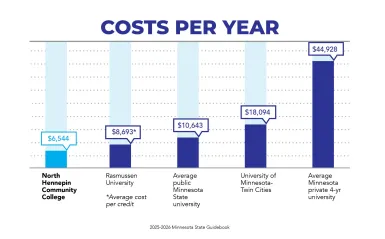
Financial Aid
- Scholarships are money you don't have to repay
- Grants are money you don't have to repay

Free College Tuition
The North Star Promise scholarship program provides free college tuition to eligible students. Find out if you might be eligible.
Earn a $2,500 Scholarship!
In addition to NHCC scholarships, the college will be awarding $2,500 Workforce Development Scholarships that encourage and reward students pursuing high-demand occupations. Exercise Science is a high-demand field and Exercise Science students are eligible to apply for a $2,500 Workforce Development Scholarship.
Program Roadmaps
Program roadmaps provide students with a guide to understand the recommended course sequence to complete their degree.
Peace Officer / Public Safety Pathway Curriculum
| Course Code | Title | Course Outlines | Goal Areas | Credits |
|---|---|---|---|---|
| ENGL 1200 | College Writing I with Workshop OR | View-ENGL 1200 | 01 | 4 |
| ENGL 1201 | College Writing I AND | View-ENGL 1201 | 01 | 4 |
| ENGL 1202 | College Writing II OR | View-ENGL 1202 | 01,02 | 2 |
| ENGL 1203 | College Writing II with Workshop AND | View-ENGL 1203 | 01,02 | 2 |
| PSYC 1165 | Psychology of Adjustment AND | View-PSYC 1165 | 05,7B | 3 |
| SOC 1110 | Introduction to Sociology AND | View-SOC 1110 | 05,7B | 3 |
| SOC 1710 | Introduction to Criminal Justice AND | View-SOC 1710 | 05 | 3 |
| SOC 1720 | Police and Community AND | View-SOC 1720 | 3 | |
| SOC 1730 | Juvenile Justice AND | View-SOC 1730 | 3 | |
| SOC 1750 | Families in Crisis AND | View-SOC 1750 | 05 | 3 |
| SOC 2110 | Principles of Social Psychology | View-SOC 2110 | 7A,05 | 3 |
| Course Code | Title | Course Outlines | Goal Areas | Credits |
|---|---|---|---|---|
| EXSC 1010 | Physical Fitness OR | View-EXSC 1010 | 2 | |
| EXSC 1530 | Tactical Strength and Conditioning | View-EXSC 1530 | 2 | |
| (highly recommended) AND | ||||
| HLTH 1600 | Emergency Medical Responder AND | View-HLTH 1600 | 3 | |
| COMM 1110 | Principles of Interpersonal Communication AND | View-COMM 1110 | 01,7A | 3 |
| PHIL 1020 | Ethics AND | View-PHIL 1020 | 06,09 | 3 |
| Natural Sciences Mathematics/Logical Reasoning (Goal Area 3 4) - 4 credits: ANTH1020(3), BIOL1000(4), BIOL1001(4), BIOL1002(4), BIOL1030(4), BIOL1101(4), BIOL1102(4), BIOL1120(3), BIOL1130(4), BIOL1140(4), BIOL1160(4), BIOL1200(4), BIOL1350(3), BIOL1360(4), BIOL1610(1), BIOL1650(1), BIOL2020(4), BIOL2030(4), BIOL2100(4), BIOL2111(4), BIOL2112(4), BIOL2360(4), CHEM1000(4), CHEM1005(3) CHEM1010(4), CHEM1030(4), CHEM1061(4), CHEM1062(4), CHEM2061(5), CHEM2062(5), GEOG1010(3), GEOL1010(2), GEOL1020(2), GEOL1030(2), GEOL1040(2), GEOL1110(4), GEOL1120(4), GEOL1130(4), GEOL1150(4), GEOL1160(4), GEOL1850(3), GEOL1851(1), MATH1010(3), MATH1031(3), MATH1032(3), MATH1080(3), MATH1090(4), MATH1130(3), MATH1140(3), MATH1120(3), MATH1150(3), MATH1160(4), MATH1170(4), MATH1180(5), MATH1190(5), MATH1200(3), MATH1221(5), MATH1222(5), MATH2010(3), MATH2220(5), MATH2300(4), MATH2400(4), NSCI1000(4), NSCI1010(1), NSCI1020(1), NSCI1030(1), NSCI1050(4), NSCI1060(3), NSCI1061(1), NSCI1070(3), NSCI1071(1), NSCI1110(4), NSCI1120(4), NSCI1200(3), PHIL1050(3), PHYS1000(4), PHYS1030(4), PHYS1050(4), PHYS1060(3), PHYS1061(1), PHYS1070(3), PHYS1071(1), PHYS1120(4), PHYS1140(3), PHYS1201(5), PHYS1202(5), PHYS1231(4), PHYS1232(3), PHYS1400(3), PHYS1410(1), PHYS1450(3), PHYS1460(1), PHYS1601(5), PHYS1602(5) | ||||
| POLC 2225 - Criminal Investigation | ||||
| POLC 2230 - Legal Issues | ||||
| POLC 2231 - MN Criminal Traffic Codes | ||||
| POLC 2235 - Police Report Writing/Interview | ||||
| POLC 2241 - Crisis Intervention Human Behavior | ||||
| POLC 2262 - In Progress Response | ||||
| POLC 2276 - Traffic | ||||
| POLC 2281 - Defensive Tactics | ||||
| POLC 2285 - Crime Scene Evidence | ||||
| POLC 2291 - Firearms | ||||
| POLC 2300 - Tactical Driving |
| Total Credits Required | 68 |
|
Notes
Applicants to the theory based courses of the Professional Licensing Program must complete the nine prerequisite courses, or their equivalent, with at least a C grade (2.00 on a 4.00 scale) in each course and a cumulative GPA of 2.5. US citizenship is not required for admission to the Professional Licensing Program, however, applicants must be US citizens before being hired by a law enforcement agency. Applicants may not be convicted of a crime that would prohibit them from being admitted to the law enforcement program under the rules of the Minnesota Board of Peace Officer Standards and Training (POST). |
|
2025-2026
The Peace Officer / Public Safety Pathway AS offers students a powerful option: the opportunity to complete an AS degree with course credits that directly transfer to designated Peace Officer / Public Safety degree programs at Minnesota State universities. The curriculum has been specifically designed so that students completing this pathway degree and transferring to one of the seven Minnesota State universities enter the university with junior-year status. All courses in the Transfer Pathway associate degree will directly transfer and apply to the designated bachelor's degree programs in a related field.
The Minnesota State Universities: Bemidji State University; Metropolitan State University; Minnesota State University, Mankato; Minnesota State University Moorhead; Southwest Minnesota State University; St. Cloud State University; and Winona State University.
Develop a foundation of essential knowledge about the cultural, social, and natural worlds, including:
- analyzing the history, organization and functions of the criminal justice system including legal issues, the purpose and function of police, courts, and corrections. (ELO 1)
- interpreting political, cultural and social class forces which impact the police, suspects, victims, and other parties involved in law enforcement, with a focus on conscious and implicit bias. (ELO1)
Develop intellectual and practical skills, including:
- communicating effectively in work situations. (ELO 2a, 2b, 2c, 2d, 2e)
- obtaining and refining the necessary skills in interpersonal communication, mathematics, basic crime statistics, and report writing, as these skills relate to public contact and criminal activity. (ELO 2c, 2d, 2e)
- utilizing the intellectual and practical skills necessary to represent a public agency in a professional manner and with cultural competency during routine public contacts, high stress situations, and arrests. (ELO 2a, 2b, 2c, 2d, 2e)
Demonstrate personal and social responsibility, including:
- identifying career opportunities in public law enforcement and private security agencies and the attributes that employers are seeking and creating an understanding that employers often require continued higher education, citizenship, and service to others for initial placement and promotion.
- developing a basic understanding of race, sex, color, religion, age, national origin, disability, marital status, status with regard to public assistance, sexual orientation, gender identification, and social class as related to criminal justice issues. This basic understanding should lead to tolerance, valuing differences, and leading to the acceptance of others.
Demonstrate personal and social responsibility, including:
- identifying career opportunities in public law enforcement and private security agencies and the attributes that employers are seeking and creating an understanding that employers often require continued higher education, citizenship, and service to others for initial placement and promotion. (ELOs 3a, 3b)
- examining race, sex, color, religion, age, national origin, disability, marital status, status with regard to public assistance, sexual orientation, gender identification, and social class as related to criminal justice issues. This examination will follow anti-racist education principles and should lead to acknowledgement of conscious or implicit bias, tolerance, valuing differences, and leading to the acceptance of others. (ELOs 3a, 3b, 3c, 4b)
Demonstrate integrative and applied learning, including:
- assessing the history and application of Criminal Justice with respect to Law Enforcement, as well as its relationship to the other social sciences. (ELOs 3d, 4c, 4d, 4e)
- applying concepts used in the Law Enforcement profession across classes and in their lives. (ELOs 3d, 4b, 4c, 4d, 4e)
- analyzing techniques and strategies used in crime investigation, patrol operations, and daily police work to then employ in their future work.
Upon completion of the program, be prepared to transfer to a baccalaureate program.
Program roadmaps provide students with a guide to understand the recommended course sequence to complete their degree.
Information on careers, including career descriptions, salary data, and employment outlook is available on the Bureau of Labor Statistics website and O*Net Online website.
If you are planning on transferring to another institution, follow the guidelines available on our transfer resources web page to help you plan the process: Transfer Information
The Associate of Science (A.S.) degree is intended for students whose primary goal is to complete the credentials for a specific career and/or prepare for transfer to complete a bachelor's degree at a college or university with whom North Hennepin Community College has an articulation agreement. The A.S. degree provides a balance of general education courses and the required scientific, professional or technical courses in the degree program.
A student shall:
- Earn a minimum of 60 semester credits as required in the program, with a grade point average of 2.00 (C) or above in courses taken at North Hennepin Community College. Specific programs may have additional requirements or a higher minimum grade point average.
- Earn a minimum of 15 semester credits at North Hennepin Community College. A student must complete at least 50% of career specific courses at North Hennepin Community College.
- Earn 30 credits in at least 6 Minnesota Transfer Curriculum (MnTC) goal areas.
- Earn 30 professional/technical credits.
- Have four years to complete the graduation requirements as published in the catalog in effect at the time of their initial enrollment. Students taking more than four years to complete their graduation requirements may follow any catalog published during the four year period preceding their graduation.
Completion of an A.S. degree fulfills the Goal Area 2 requirement of the Minnesota Transfer Curriculum (MnTC).
Developmental Courses Some students may need preparatory course(s) in Math and/or English. Courses numbered below 1000 will not apply toward a degree.
Equal Opportunity Employer and Disability Access Information North Hennepin Community College is a member of Minnesota State Colleges and Universities system and an equal opportunity employer and educator. This document is available in alternative formats to individuals with disabilities by calling 7634930555 or through the Minnesota Relay Service at 18006273529.
North Hennepin Community College is accredited by the Higher Learning Commission (hlcommission.org), an institutional accreditation agency recognized by the U.S. Department of Education.
30 N. LaSalle Street, Suite 2400
Chicago, IL 60602-2504
1-800-621-7440
Course Title: College Writing I with Workshop Goal Areas: Credits: 4
Course Description: This class provides extended practice in critical reading, writing, and thinking skills. Students will develop an effective writing process and work to achieve college-level competence in reading and responding to texts, visuals, events, and ideas in a variety of written formats. Audience awareness, interpretation and analysis, logical reasoning, and persuasive and argumentative skills will be developed. MLA style documentation of primary and secondary sources will be included.
Course Title: College Writing I Goal Areas: Credits: 4
Course Description: This class provides extended practice in critical reading, writing, and thinking skills. Students will develop an effective writing process and work to achieve college-level competence in reading and responding to texts, visuals, events, and ideas in a variety of written formats, with an emphasis on the academic essay. Audience awareness, interpretation and analysis, logical reasoning, and persuasive and argumentative skills will be developed. MLA style documentation of primary sources will be included.
Course Title: College Writing II Goal Areas: Credits: 2
Course Description: This class focuses on the research process, textual analysis of primary and secondary sources, rhetorical strategies for argument and persuasion, and successful integration of sources into a longer academic paper utilizing MLA (or other, as appropriate) documentation format. The class may be disciplinary, interdisciplinary, or topical in content.
Course Title: College Writing II with Workshop Goal Areas: Credits: 2
Course Description: This class focuses on the research process, textual analysis of primary and secondary sources, rhetorical strategies for argument and persuasion, and successful integration of sources into a longer academic paper utilizing MLA (or other, as appropriate) documentation format. The class may be disciplinary, interdisciplinary, or topical in content.
Course Title: Psychology of Adjustment Goal Areas: Credits: 3
Course Description: This course is an in-depth look at the processes of normal human adjustment and their application in the student's life adjustment. A component of the course is diversity and dealing with diversity, specifically the development and changing group identities in the U. S.; an examination of the individual and institutional processes of unequal power between groups; an examination of the students' attitudes, behavior and beliefs about diversity, stereotyping, prejudice, bias and racism and bigotry; and experience in developing the necessary communication skills for living and working in a diverse society. Other topics may include goal setting and change processes, self-awareness and identity, physical and psychological health, stress and coping, interpersonal relationships and communication, emotions and motivation, social interactions, psychological growth and development, meaning and values, and decision making.
Course Title: Introduction to Sociology Goal Areas: Credits: 3
Course Description: This course introduces students to the practice of thinking sociologically. The class focuses on cultivating and applying the sociological imagination: the capacity to understand the connections between personal troubles and social issues. We start with the sociological theories and concepts. We then explore social institutions, and their relationships with individuals. Topics include but are not limited to culture, research methods, roles and norms, groups, deviance, social and cultural change, and inequalities in race, class, gender, and sexuality.
Course Title: Introduction to Criminal Justice Goal Areas: Credits: 3
Course Description: This course covers the history, organization, and function of the criminal justice system in the United States. Topics include foundations of crime and justice, victimization, crime statistics and the extent of crime, police issues, court systems, corrections, and future trends. Note: Sociology 1110 recommended prior to taking this course.
Course Title: Police and Community Goal Areas: Credits: 3
Course Description: This course addresses the affective-oriented aspects of contemporary law enforcement. Topics include crime prevention, police community relations, ethical decision-making, cultural diversity, bias-motivated crimes, domestic abuse, problem solving, volunteerism, and interpersonal communications. Note: SOC 1110, Introduction to Sociology, recommended before taking this class.
Course Title: Juvenile Justice Goal Areas: Credits: 3
Course Description: This course analyzes the juvenile justice system and its historical and philosophical development, including theories of social causes and effects of delinquency. Students will learn strategies for working with juveniles and for preventing and investigating delinquency. The course provides a working knowledge of Minnesota statutes pertaining to juveniles through the study of case law, report writing, skills exercises, and simulation.
Course Title: Families in Crisis Goal Areas: Credits: 3
Course Description: This course analyzes the dimensions and dynamics of family dysfunctions. Topics may include, domestic abuse, child abuse and protection, vulnerable adults, peace officer response to crime victims, Americans with Disabilities Act as it relates to peace officers, mental health, poverty, homelessness, and the substance abuse as related to family issues. Prerequisite: Soc 1110
Course Title: Principles of Social Psychology Goal Areas: Credits: 3
Course Description: This course examines the major theories and classic research studies of Social Psychology. We will analyze how individuals thoughts, feelings and actions are influenced by others. Topics include perception, attraction, altruism, aggression, attitudes, leadership, conformity and obedience, stereotyping and prejudice, persuasion and propaganda and the self-concept.
Course Title: Physical Fitness Goal Areas: Credits: 2
Course Description: This course offers a dynamic approach to boosting both cardiovascular health and muscular strength by engaging in various training approaches. Participants will make use of cutting-edge strength training and cardiorespiratory equipment, tailored to their unique heart rate zones for optimal monitoring and effectiveness. An initial fitness assessment will establish a baseline for setting personal goals, while a concluding evaluation will highlight progress and identify ongoing focus areas. Additionally, the course will provide insights into maintaining a healthy lifestyle, with the ultimate aim of integrating fitness and well-being into daily life for the long term.
Course Title: Tactical Strength and Conditioning Goal Areas: Credits: 2
Course Description: This course is designed specifically for the tactical athlete (military, peace/public safety officers, fire and rescue, protective services, first responders, and other emergency services). The tactical strength and conditioning course is designed to increase the performance, readiness, and longevity of tactical athletes while decreasing the likelihood of fitness and job-related injuries by utilizing proven training methods and team training.NOTE: Students are required to actively participate in weekly workouts during scheduled class times as part of the course requirements to earn credit.
Course Title: Goal Areas: Credits:
Course Description:
Course Title: Emergency Medical Responder Goal Areas: Credits: 3
Course Description: The course provides training in emergency medical care for persons who are apt to be responding to accidents. The course emphasizes the development of skills in patient assessment and emergency medical procedures. The goal is to prepare you for work in the emergency medical arena as a first responder. The course will provide you with the information needed to make competent decisions regarding medical and trauma patients.
Course Title: Principles of Interpersonal Communication Goal Areas: Credits: 3
Course Description: This introductory course looks at communication in one-to-one relationships in friendships, families, the workplace, and elsewhere. Students will be challenged to discover and assess their own communication strengths and weaknesses as they define and discuss what it means to be a competent interpersonal communicator. Course content includes both theory and practice (skill development).
Course Title: Ethics Goal Areas: Credits: 3
Course Description: This course will introduce students to both the methods and issues connected with thinking about morality and ethical systems. Moral skepticism will also be examined. The aim of this class is to allow students to be more aware of their own ethical modes of thinking and the diversity of ways morality enters into human lives.
Course Title: Goal Areas: Credits:
Course Description:
Course Title: Goal Areas: Credits:
Course Description:
Course Title: Goal Areas: Credits:
Course Description:
Course Title: Goal Areas: Credits:
Course Description:
Course Title: Goal Areas: Credits:
Course Description:
Course Title: Goal Areas: Credits:
Course Description:
Course Title: Goal Areas: Credits:
Course Description:
Course Title: Goal Areas: Credits:
Course Description:
Course Title: Goal Areas: Credits:
Course Description:
Course Title: Goal Areas: Credits:
Course Description:
Course Title: Goal Areas: Credits:
Course Description:
Course Title: Goal Areas: Credits:
Course Description:
Get Started
If you're ready to get started, apply to NHCC. If you'd like to learn more, you can visit campus or request information.

