
The Prominence of the Anti-Vaxxer Movement in the United States
By Yibamiemunu Ofo-Odo
As a kid, my dad told stories about his interactions with people and knowledge of world cultures from his travels. He spoke to me about the “free world,” and though I was young, I understood it to be a place where people were just allowed to exist, regardless of worldly distinctions. Now that I am older, I know nothing is that simple because with freedom comes responsibility.
The United States is widely regarded as a country for the people; a country of democracy and where people can live their lives free of condemnation or fear of persecution. A part of representing a land for the people is giving the right of self-determination and self-preservation. The problem is that people’s idea of these rights does not always align with their responsibilities to society. Thus, the anti-vaxxer movement is an example of an idea that is (at best) a clear indicator of the right to self-determination, and (at worst) an irresponsible position with dire consequences.
The concept of vaccination has existed for a long time in various parts of the world. It dates to at least the early 1000s in parts of Asia, Africa, and other regions, which means anti-vaccination rhetoric has been around for just as long. This rhetoric was heavily influenced by religion and pseudoscience. Specifically, the anti-vaxxer movement began in the 18th century in the United States with religious leaders describing vaccines as the devil’s work (Kandola). Instead, a medical procedure, known as variolation, became the more popular treatment for smallpox. It involved injecting small amounts of cow pox into people. Though the procedure's 2% fatality rate was considerably less than smallpox's estimated 30% fatality rate, people's hostility simply increased because they considered it unnatural to interfere with God's work” (Haelle).
This sentiment continued into the 19th century. In 1809, Massachusetts became the first state in the world to pass mandatory vaccination laws. Other states soon passed similar laws in response to smallpox outbreaks, and resistance increased considerably. The consequences of breaking these laws were often as serious as jail time, so people became even more suspicious. However, it was also observed that many of the resistors were poor people (Haelle). Afterall, when you cheat, manipulate and exploit people for cheap labor, they become suspicious of your intentions towards them, no matter how much you sugarcoat it. Therefore, the oppressed eventually grew wary of their oppressors and so resisted even well-intentioned practices, such as the mandatory vaccinations.
According to the History of Vaccines, there have been many anti-vaccine movements. In fact:
Toward the end of the 19th century, smallpox outbreaks in the United States led to vaccine campaigns and related anti-vaccine activity. The Anti Vaccination Society of America was founded in 1879, following a visit to America by leading British anti-vaccinationist William Tebb. Two other leagues, the New England Anti Compulsory Vaccination League (1882) and the Anti-vaccination League of New York City (1885) followed. The American anti-vaccinationists waged court battles to repeal vaccination laws in several states, including California, Illinois, and Wisconsin. (“History of Anti-Vaccine Movements”)
For instance, after the 1902 smallpox outbreaks resulted in state mandated vaccinations, numerous individuals believed these mandated vaccines infringed on their individual rights. One person, Henning Jackson, refused vaccination which resulted in the city filing criminal charges against him. After losing the case locally, he appealed to the United States Supreme Court. He lost again but his case would eventually be known as the first U.S court case regarding the power of states in public health.
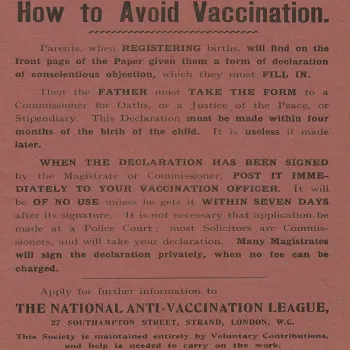
These Anti-Vaccination Movements and groups have long fought against vaccinations and have promoted anti-vaccination rhetoric, as seen in figure one, which features a pamphlet informing parents how to avoid the smallpox vaccine. This demonstrates the start of a shift from its “humble” beginnings, and how anti-vaccination propaganda has evolved beyond religious theories in the United States. Afterall, in the 21st century, more people are distancing themselves from religion. While the majority of anti-vaxxers are still religious, the numbers are evening up (Gabbatt). While is change is not always seen in the propaganda, anti-vaxxers reject almost all vaccines on the grounds of their concerns of efficacy, safety, and adverse effects (not just religious objections)
The people who reject the use of vaccines all have varying degrees of justification. One of the leading figures for the movement was Lea Thompson, a reporter. In 1982, she created a television program that debated vaccines and linked childhood disabilities to the DTaP vaccine. Thompson's campaign against vaccines prompted the formation of the anti-vaxxing group, Distraught Parents Together (DPT) that same year, which later evolved into the influential National Vaccine Information Centre (Iannelli)[NA1.1]. It was also this organization that proposed the theory that sudden infant death syndrome (SIDS) was caused by the hepatitis B.
However, Iannelli argues that while some consider Lea to be the spark that ignited modern anti-vaxxer movement, others had a hand in its later iterations.[NA2.1] One of those studies was conducted by Andrew Wakefield, a British gastroenterologist and medical researcher. In 1998, he published an article in a medical journal that proposed the measles, mumps and rubella (MMR) vaccines may “predispose to behavioral regression and pervasive development disorder in children”. This led to vaccination rates dropping and the general concern that vaccines could lead to autism (Canal). In an unsurprising turn of events, the article was debunked, and Britain’s General Medical Council revoked Wakefield's medical license. An investigation later revealed he had falsified facts and cherry-picked data to use.
Although a lot of these theories have been debunked, the damage they caused remains strong and unchanging, with people still choosing to remain steadfast in their anti-vaccination beliefs. The advancement of technology and social media also means that people are better able to create forums and mobilize others to join and promote these theories. Social media personalities also seem to be drawn towards controversies and will give these people a platform to garner views and attention. One popular online personality that holds these views is Robert F. Kennedy Jr., a candidate for the 2024 presidential election. While he insists that he is not anti-vaccination, he has stated multiple debunked claims about vaccines, including the claim that vaccines caused autism (“Fact-checking RFK Jr’s views”).
In recent times, COVID-19 was the biggest pandemic that drew attention to the anti-vaxxer movement. The pandemic revealed that there is still a strong community of anti-vaxxers in the United States. At the peak of the pandemic, people were fearful for their lives and were trying to come up with ways to adjust to the new normal, especially in the face of lockdowns. Therefore, rampant misinformation was not unusual. It was an era of fear and uncertainty, and people were skeptical of the government. Therefore, what may have started out as a noble cause with people aiming to navigate and understand the issue, derailed to a proponent of harmful rhetoric with serious, life-threatening consequences. Official studies have been done to estimate the number of lives saved by the vaccine, but also the number of preventable deaths. According to a study done by the European Journal of Epidemiology, the estimated number of preventable deaths in the United States is averaged at 232,000 people (Jia et al. 1125-128)
Since then, an increasing number of people have been inquiring if political affiliations influence the use of vaccines. It was not entirely shocking that there was an increase in the candidness of anti-vaxxers during the COVID-19 pandemic, especially since the President shared the same sentiments. Probably the first U.S president to be anti-vaccination on record is the forty-fifth president, Donald Trump, who has been very open about his anti-vaccination beliefs in the past. Trump has shown concern about the impact of receiving multiple vaccinations for kids. This concern is wildly popular among anti-vaxxers, even though it has been debunked. Currently, children receive about fifteen shots in the first eighteen months of their life to protect them against fourteen diseases, including diphtheria and measles. A panel of experts regularly review the schedule and report to the Center for Disease Control and Prevention (CDC). Though modern vaccines immunize against more diseases than older ones did, they are far more benign. According to Dr. Sean O’Leary, a member of the American Academy of Pediatrics’ committee on infectious diseases, the current schedule exposes young children to about 100 antigens, the toxins that prompt the body to produce immunities. In the 1990s, toddlers were exposed to about 3,200 antigens from vaccines for just two diseases: smallpox and pertussis (Hoffman “President Trump on Vaccines”).
Of course, the above were no the only instances of this. Long before Trump pursued his presidency, he shared some concerns about the effects of vaccines vis-à-vis autism when he likened vaccines to a “monster shot” in 2012. Then on Autism Awareness Day in April, Trump called in to Fox and Friends. The hosts noted that most physicians disagreed with his theory that vaccines cause autism: “Well, it’s also very controversial to even say, but I couldn’t care less. I mean, I’ve seen people, where they have a perfectly healthy child, and they go for the vaccinations, and a month later the child is no longer healthy” (Hoffman “President Trump on Vaccines”). As such, he continues to push anti-vaccination rhetoric and thus furthers a divide between political affiliation and vaccination.
In 2021, researchers studying the link between political affiliations and anti-vaccination found that people who were Pro-Trumpers were three times more likely to die from COVID-19 than those who were Pro-Biden (Wood). In addition, according to NPR in October of that year, the reddest states of the country saw death rates that were six times higher than in the bluest states (Wood). Furthermore, recent polling shows that partisanship is now the single strongest predictor of whether someone is vaccinated or not. Polling also shows that mistrust in official sources of information and exposure to misinformation, about both COVID-19 and the vaccines, run high among Republicans.
While vaccine hesitancy exists in many different groups, the deaths are overwhelmingly concentrated in more politically conservative communities. Therefore, misinformation appears to be a major factor in the lagging vaccination rates. According to the Kaiser Family Foundation's polling, Republicans are far more likely to believe false statements about COVID-19 and vaccines. In 2021, a full 94% of Republicans thought one or more false statements about COVID-19 and vaccines might be true, and 46% believed four or more statements might be true. By contrast, only 14% of Democrats believed four or more false statements about the disease were true, which further demonstrates the impact of misinformation and partisanship regarding vaccines (Wood).
As a result, religion is no longer the major driving force for antivaxxers in the United States. People expect the government to be transparent and accountable, especially in democracy. However, the lack of said transparency has encouraged people to rely on widely undependable sources of information. In a bid to avoid the propaganda shared by “mass media”, people end up digging themselves into even deeper misinformation by relying on unsupported sources that often convey fringe-group perspectives and speculations about vaccinations. Therefore, it is pertinent to address some of these speculations.
Major organizations, like World Health Organization (WHO), have been proactive in trying to address some of these theories. For instance, the concern that vaccines may cause SIDS has been extensively addressed, yet this belief continues because a moderate proportion of children who die of SIDS have recently been vaccinated with DTP. On the surface, this seems to point toward a causal connection; however, this logic is faulty—you might as well say that eating bread causes car crashes, since most drivers who crash their cars could probably be shown to have eaten bread within the past 24 hours.
If you consider that most SIDS deaths occur during the age range when three shots of DTP are given, you expect DTP shots to precede a fair number of SIDS deaths simply by chance. In fact, when several well-controlled studies were conducted during the 1980s, the investigators found, nearly unanimously, that the number of SIDS deaths temporally associated with DTP vaccination was within the range expected to occur by chance. In other words, the SIDS deaths would have occurred, even if no DTP vaccinations had been administered. In fact, the studies found that children who had recently received a DTP shot were less likely to suffer SIDS. The Institute of Medicine reported, "all controlled studies that have compared immunized versus non-immunized children have found either no association . . . or a decreased risk . . . of SIDS among immunized children," and concluded, "the evidence does not indicate a causal relation between [DTP] vaccine and SIDS." (“Vaccines and Immunization").
Some people assume that because diseases, like polio, have disappeared from the United States, it is no longer necessary to vaccinate children for them. However, polio is still widespread in other parts of the world and could easily begin reinfecting unprotected individuals if it were reintroduced into the country. Another example is measles, which has become rare in the United States. However, U.S. outbreaks have occurred when Americans traveling to countries where measles remains widespread brought the disease back with them. With adequate vaccination rates, most of these outbreaks can be prevented. But if vaccination rates drop, “imported” cases of preventable diseases can spread again. In the early 2000s, for example, low vaccination rates in England allowed measles to become endemic after earlier vaccination rates had halted its continuous transmission in the country (“Misconceptions”).
In addition, epidemiologic and immunologic data, supported by biological evidence, refute the fear that vaccines can weaken the immune system or cause autoimmune disease (Geoghegan et al. 372). A study in Canada investigating the impact of vaccination on immune status compared the immune response to general, non-antigen-specific stimuli in entirely unvaccinated versus vaccinated children at 3–5 years of age. When investigators compared adaptive and innate responses, they did not find any difference in immunological outcomes in vaccinated children (Geoghegan et al. 372).
Enough research has been done to disprove many concerns regarding vaccines, but the theories persist. People remain apprehensive towards them and feel as though their criticism is not taken seriously. We saw this happen in the recent measles outbreak in Texas. As many as 124 mostly unvaccinated people were infected, and in response to the crises, the Texas government started a campaign to encourage people to receive the MMR vaccination. Following this, self-proclaimed "wellness” groups accused medical professional and facilities of using the MMR vaccine to inject measles into people, thereby causing the measles outbreak they were responding to (Zadrozny “Anti-vaccine”). In an interview with Sayer Ji and Polly Tommey on a morning show hosted by Children’s Health Defense (an anti-vaccine nonprofit, formerly led by Robert F. Kennedy Jr.), they purported that the government was pushing an agenda against anti-vaccination, while endangering lives with the MMR vaccine. Interestingly, this theory was already pushed by Robert F. Kennedy Jr. in the past. During the measles outbreak in Samoa in 2019, he wrote to the island’s minister to warn them about the vaccine. Then he told an interviewer that nobody died from measles because they all died from a “bad vaccine” (Zadrozny “Anti-vaccine”). However, the MMR vaccine has been proven to be abundantly safe and that these “concerns” about it are needlessly inflammatory and entirely false.
There is another angle to anti-vaccination that has not been considered. When COVID-19 vaccines became available, people were concerned that black communities would choose to not receive vaccination because of the distrust they had in the healthcare system. In a survey done by the National Association for the Advancement of Colored People (NAACP), it found that only 14% of respondents trusted the vaccines’ safety (Bajaj and Stanford). Now, unlike prior concerns, these are based on mistreatment and racism. In discussing the distrust some black communities have towards vaccines, people point to 3 historical atrocities: First, the work of James Marion Sims, the so-called “father of Gynecology,” who performed surgeries on enslaved, black women without their knowledge or consent (Galarneau). Then, there is the use of HeLa cells, which were essentially stolen from a black woman, Henrietta Lacks, and then used for medical research without her consent (“The stolen legacy”). Third, the Tuskegee study of syphilis which was conducted by the United States Public Health Service and CDC. This study was done on six hundred black men, none of which gave informed consent. More than half of those men had syphilis, but the two departments neglected to offer treatment for the disease when it became available to study the effects of untreated syphilis (“About the Untreated Syphilis Study”).
These are all documented cases of the mistreatment of black people in the healthcare system. It may be tempting to simplify the black community’s distrust in medical professionals to these cases, but these cases are more complicated than that. They provide important context, but “every day, black Americans have their pain denied, their conditions misdiagnosed, and necessary treatment withheld by physicians” (Bajaj and Stanford). It is unlikely that their hesitance towards vaccines (and medical care in general) is because they are always thinking of Tuskegee; rather, it is likely a response to their own personal and familial experiences within the system (Bajaj and Stanford).
Now, I want to say that the solution to these cases is as simple and straightforward as ending racism, but seeing as that has been a problem since the creation of the United States, the issue is much more complex. The previous approach to bridging the gap has been implementing cultural sensitivity training into healthcare and encouraging professionals to examine their own biases, while recognizing previous harm. The current administration has chosen to go down a different path, and we have yet to see the long-term effects of what that solution will be. But seeing as this path involves dismissing and dismantling aspects of black history, such as the attempts to remove exhibits about Harriet Tubman and the underground railroad, (Walk), I doubt the effects will translate into positive views on the healthcare system.
The topic of anti-vaccination in the United States can be polarizing. As it affects human lives, people are generally not interested in compromising, for better or worse. We see that medical professionals are not infallible, so criticism is necessary and valid. However, that criticism should be geared towards enhancing the system and promoting transparency, not diminishing earlier efforts and regurgitating already disproven claims. People need to resist the urge to be swayed by sensational headlines and isolated incidents as proof of widespread conspiracy. And most importantly, political officials and medical professionals need to show a vested interest in promoting the overall health of the people they serve by prioritizing evidence-based care. Only then can we expect a clear path forward.
Works Cited
“About The Untreated Syphilis Study at Tuskegee.” The U.S. Public Health Service Untreated Syphilis Study at Tuskegee, 4 Sept. 2024, www.cdc.gov/tuskegee/about/index.html.
Bajaj, Simar Singh, and Fatima Cody Stanford. “Beyond Tuskegee — Vaccine Distrust and Everyday Racism.” The New England Journal of Medicine, vol. 384, no. 5, p. 12, 20 Jan. 2021, doi:10.1056/nejmpv2035827.
Canal, Gabriella. “Understanding Anti Vaxxers and Their Opposition to Vaccines.” Global Citizen, 7 Mar. 2017, www.globalcitizen.org/en/content/everything-you-need-to-know-about-the-….
“Fact-checking RFK Jr’s views on health policy.” BBC News, 15 Nov. 2024, www.bbc.com/news/articles/c0mzk2y41zvo.amp.
Gabbatt, Adam. “Losing their religion: why US churches are on the decline.” The Guardian, 23 Jan. 2023, www.theguardian.com/us-news/2023/jan/22/us-churches-closing-religion-co….
Galarneau, Charlene. “On Sims’s Legacy: Work for Bioethics.” The Hastings Center for Bioethics, 17 Aug. 2017, www.thehastingscenter.org/sims-legacy-work-bioethics.
Geoghegan, Sarah et al. “Vaccine Safety: Myths and Misinformation.” Frontiers in Microbiology, National Library of Medicine, vol. 11, p. 372. 17 Mar. 2020, doi:10.3389/fmicb.2020.0037.
Haelle, Tara. “Vaccine hesitancy is nothing new. Here’s the damage it’s done over centuries.” ScienceNews, 11 May 2021, www.sciencenews.org/article/vaccine-hesitancy-history-damage-anti-vacci….
“History of Anti-Vaccination Movements.” History of Vaccines, 20 Apr. 2022, historyofvaccines.org/vaccines-101/misconceptions-about-vaccines/history-anti-vaccination-movements.
Hoffman, Jan. “President Trump on Vaccines: From Skeptic to Cheerleader.” The New York Times, 11 Mar. 2020, www.nytimes.com/2020/12/18/us/politics/trump-vaccine-skeptics.html.
Iannelli, Vincent. “Anti-Vaccine Movement Timeline and History.” Vaxopedia: An A to Z Guide on Vaccines, 4 Jun. 2017, Anti-Vaccine Movement Timeline and History - VAXOPEDIA
Jia, Katherine M. et al. “Estimated preventable COVID-19-associated deaths due to non-vaccination in the United States.” European Journal of Epidemiology, National Library of Medicine, vol. 11, 38, pp. 1125-1128, 24 Apr. 2024. doi:10.1007/s10654-023-01006-3.
Kandola, Aaron. “What is an Anti-Vaxxer: Definitions, Beliefs, Risks, and More.” Medical News Today, reviewed by E. Mimi Arquilla, 5 Nov. 2020, Anti-vaxxer: Definition, beliefs, risks, and more.
“Misconceptions About Vaccines.” History of Vaccines, 25 Jan. 2018
historyofvaccines.org/vaccines-101/misconceptions-about-vaccines.
“The stolen legacy of Henrietta Lacks.” Blood Cancer UK, 20 Oct. 2023, bloodcancer.org.uk/news/the-stolen-legacy-of-henrietta-lacks.
Walk, Trey. “The Trump Administration’s Assaults on Black History.” Human Rights Watch, 10 Apr. 2025, www.hrw.org/news/2025/04/10/trump-administrations-assaults-black-history. Accessed 16 Apr. 2025.
Wood, Daniel, and Geoff Brumfiel. “Pro-Trump counties now have far higher COVID death rates. misinformation is to blame.” NPR, 5 Dec. 2021, www.npr.org/sections/health-shots/2021/12/05/1059828993/data-vaccine-mi….
Zadrozny, Brandy. “Anti-vaccine movement falsely blames measles shots for Texas outbreak.” NBC NEWS, 25 Feb. 2025, www.nbcnews.com/news/amp/rcna193478.