
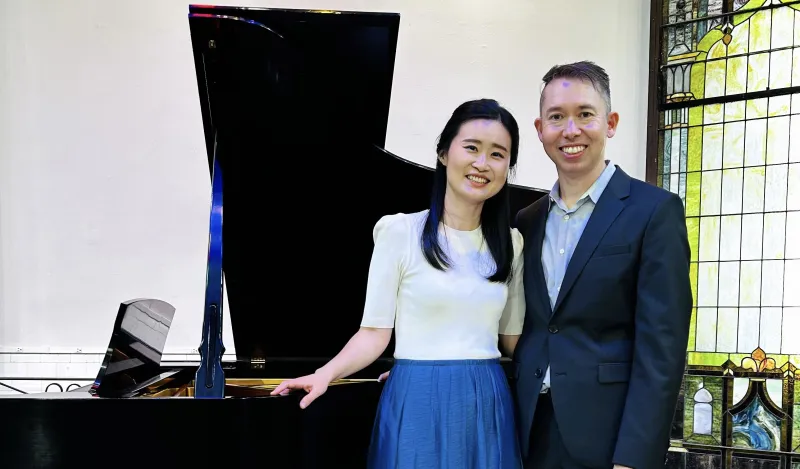
Join us for an unforgettable evening with NHCC piano faculty Dr. Grace Choi and Dr. Kevin Hobbs! From beautiful and moving moments to plenty of surprises, their recital promises to be an experience you won’t want to miss. It’s completely free, with refreshments provided (charcuterie, anyone?) and a reception afterward.
Piano Duo Recital Schedule
Date: Saturday, October 3
Time: 2:00 p.m. - 3:00 p.m.
Location: Located in the NHCC Fine Arts Center Theatre (FAC 178).
We had a chance to chat with husband-and-wife pianists and NHCC faculty, Grace Choi and Kevin Hobbs, about their upcoming recital and what it’s like performing with your spouse!
What inspired you to put this recital together?
We found this nice space, and we just wanted to play there. We've played duo stuff for a long time. Previously, we did a lot more of it, and we've played some of these pieces before, so part of it was also just, you know, once you are teaching, like working a lot, and especially once you have a child, it's like you don't really have time to practice anymore.
“Our three-year-old daughter really doesn't like when we practice. She'll say, ‘It's too loud,’ and then she'll come over, and she'll kind of try to push us away from the piano, or she'll start playing, so it's hard to find time. There's definitely certain times of the day where we can't make a peep.”
You don't have time to sit down and make music, which is what we were trained to do. When we were students getting our doctorates, it was really like, practice, practice, practice, practice, and then perform. And they even told us, when we were students, they said, when you start working, you won't have time, so practice now! Which is true because even before we had a child, we would work all day and then come home. And it's like you don't want to sit down and practice, right? You want to sit and stare at the wall or something. You want to rest.
“This kind of forces us, in a way, to go back to our roots and not just become working musicians that never perform.”
Actually, it can be kind of discouraging in a way because we're not practicing eight hours a day like we used to, so sometimes we can feel like it's not as good anymore.
How long have you both been working on this recital?
Probably not as long as we should’ve been! What began as a single performance opportunity in Owatonna gradually grew into a three-stop recital series. After planning one concert, we decided to share the program with audiences in multiple locations, and of course we wanted to share it at NHCC, because this is where we work. Mount Calvary Lutheran Church is the final recital location.
There will be some Debussy, Schoenfeld, Mozart, and Rachmaninoff in your recital; what's the musical thread connecting these pieces?
While the program isn't built around a single theme, it showcases some of the most beloved works written for piano duet, from Mozart and Debussy to Rachmaninoff and Paul Schoenfeld.
Is there a piece that you’re particularly excited for audiences to hear?
Yeah certainly! The last one, Paul Schoenfeld, it's kind of a combination of classical jazz, with some Jewish inspirations, based on what the composer went through during his career. It's a really fun one! It’s our encore piece, and it might be the most popular thing we play.
“The Schoenfeld is like a rollercoaster!”
What's it like preparing for a recital together when you're also married?
KH: Oh boy, here we go! Haha, no, I think in some ways it's a blessing that we both kind of understand each other and where we come from in our work. We've been married 11 years, have had a child for three years, and we’ve known each other for probably close to 20 years now (we met at the University of Minnesota while we were completing our doctorates). We just understand each other! Because if my wife were not a concert pianist and I said, ‘Hey, I need to practice; I can't go out with you right now,’ that might cause friction, but that doesn’t happen with us because she gets it. In some ways, she's the one who drags me to the piano! She’ll be the one to say, ‘We need to practice, we need to rehearse,’ that kind of thing. We really understand what it takes to do this kind of work and put it together. We're obviously a little closer than just two strangers that are playing together. In a way, we knew each other musically before romantically. But when I play with my wife, you get two really high-level pianists, and we'll sit down and play these pieces together; maybe we’re a little less polite with each other. At the piano, when we’re practicing, it's a lot of back and forth; we discuss music, and we also bump into each other a lot when we're playing. The choreography requires a lot of rehearsing, too, especially in that encore we hopefully get to play.
“There's a lot of planning around where your hands go during a duet.”
Sometimes while playing a duet we're really on top of each other, so you have to figure out whose hand goes where.
GC: We've been married for a long time and have known each other for a long time as a musician and as friends, so I feel we are more connected with each other and understand each other more musically and personally. So, in a way, it's easier than playing with a complete stranger. You need to also be careful how you act, because you are going to see this person all the time! So, I need to approach differences in opinion more carefully, because he'll definitely be following me home afterwards!
Do you have different approaches to preparing for recitals?
KH: I kind of feel guilty saying all these things when she's not sitting here with us, but, yeah, she's more strict with herself and more disciplined when preparing for a recital. Like, she's definitely the type that will sit down for three hours, not move, and just practice the whole time. And I take a lot more breaks, and I don't like sitting for hours and doing that. I like to play freely, just be in the moment, and she likes to be very rehearsed. She's definitely the disciplined one among the two of us. She'll say, ‘No, we need to get this ready, we need to get this right.’ After we had our first concert this past Sunday, I thought it went pretty well. I was like, ‘That went great; I feel pretty loose.’ Haha, and she’s like, ‘Yeah, no, you can't relax yet.’ She wants us to put the piano on the stage in the spot and rehearse there.
GC: Kevin likes to just follow his feelings more. For example, should we play a part softly or loudly? Kevin will say, "Oh, I'll just decide at that moment and play it like I feel." I like to plan things out and be very organized, but he is more spur of the moment. Because of this, sometimes the rehearsal can be long and difficult, so he often tries to skip or avoid rehearsing!
What's something you admire about the other person's musicianship?
KH: She's very on top of things and prepared. I'm more, it can go one way or the other, but she's a rock. She's very dependable when she plays. I definitely greatly admire her musicianship! She's very stable when she plays. When we're doing solo concerts, and I'll listen to her, I never feel like she's gonna have a problem. But she's told me, when she listens to me, she's very nervous, and she's like, ‘Oh no!’ So that's funny! Usually I'm fine, but yeah, our personalities are very different in that way. She's very type A, and I'm very type B. It's sometimes hard to reconcile those two things, but that's part of what we do when we're preparing a concert, and we figure out how to make that work.
GC: Sometimes he suggests some interesting ideas I wouldn't have thought about. He has a different musical approach and can come up with things that I don't see. Also, sometimes I focus too much on technical details, but he is able to see the music from a deeper and larger musical perspective, using knowledge about composers and music that I might not know.
What do you hope audiences take away from this experience?
I hope that the audience has a good time, but that they also feel things as we journey through these pieces.
“Music is very communicative, right? I always hope the audience feels like I'm saying things through my playing.”
And I need someone to hear those things, which is the audience, so playing by myself is never as fulfilling as playing in front of people. Each of these pieces has a different mood. Like, the Mozart is kind of lighthearted and playful, the Rachmaninoff is intense, the Debussy is light, but it's really beautiful music, and the Schoenfeld is very exciting. This is a long program, though; just the Rachmaninoff is almost 30 minutes long. I do hope that the audience doesn't get bored, that they can really feel those things that we're trying to convey through the music, and just go along with us on the ride.
We hope to see you at the recital!